A literal fifty-block span
Offsets -25 through 24 create exactly fifty cells per axis: radius 25 and block-centre reach 24.5.
EVEN-DIAMETER FIELD CARD / 25 MIRRORED PAIRS
Open the D50 builder50 × 50 / locked outside span
Set layers and origin; build 25 north/south pairs.
Four centre reference blocks
The centre is the seam point between (-1,-1), (0,-1), (-1,0), and (0,0); no single block is central.
Restores outline, stone bricks, one layer, origin 0/64/0 and clears both checklists.
Exact 50-block overhead grid
Highlighted: selected pair. Dashed axes meet between blocks.
Click or tap an occupied block to inspect it.
Focus the grid: arrows move between blocks; Home/End select first/last.
Layer 1/1 · World Y 64
Centre-gap reference: X 0 / Y 64 / Z 0 · World Y range: 64→64
No block selected
Pair 1 of 25
A built pair includes every planned layer. Each mode keeps its own checklist.
JSON/CSV store one footprint with an inclusive Y range; SVG includes plan metadata.
Gap-centred build sequence / 04
A 50 block circle Minecraft build stays aligned when measurements begin at the half-block centre and rows are checked in pairs.
Mark the seam with four temporary reference blocks. The south-east block is the world-coordinate origin.
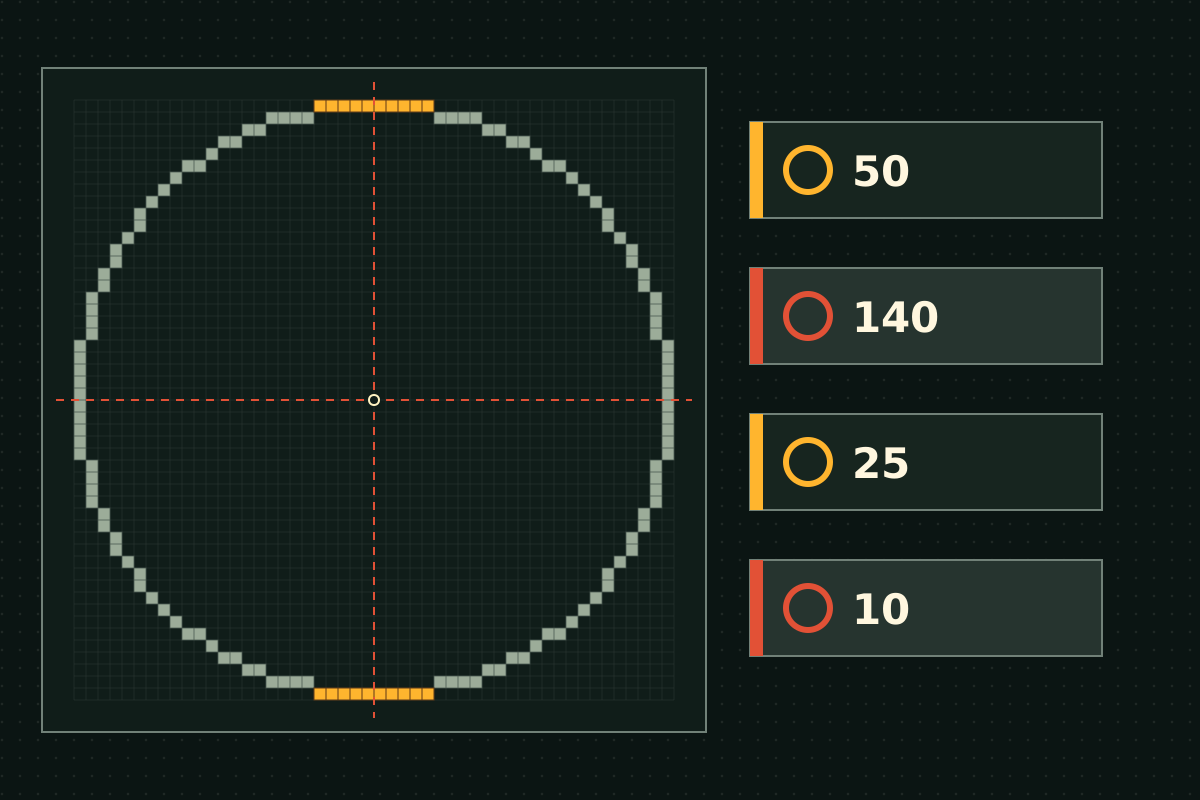
Outline mode has ten-block caps at north, east, south, and west. Verify them before filling the curves.
Place a north row, then its partner at z = -north z - 1. Repeat all twenty-five pairs.
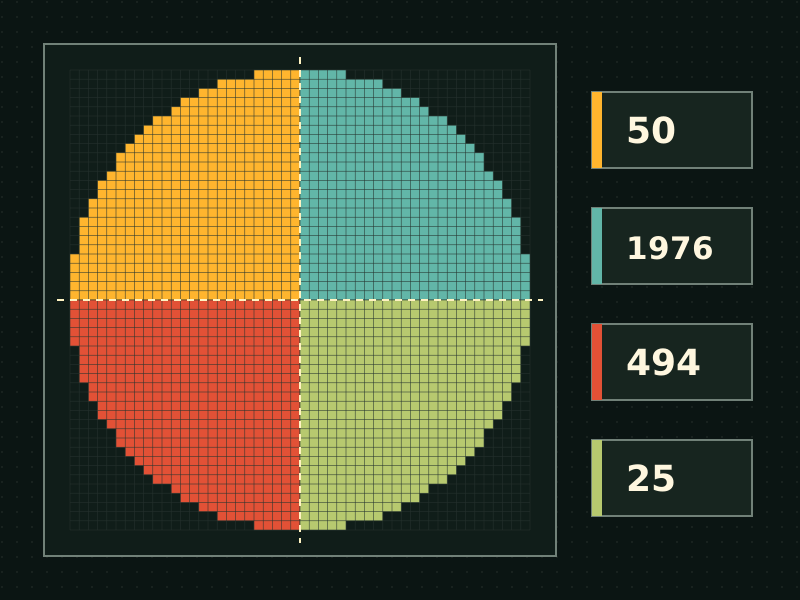
Check equal quadrants, apply layers, compare stacks, then download relative and world coordinates.
Why fifty needs its own plan
Offsets -25 through 24 create exactly fifty cells per axis: radius 25 and block-centre reach 24.5.
Fifty rows form twenty-five north/south pairs. Selection highlights their cells and prints both run segments.
Preview, runs, quadrants, stacks, checklist, copy, and JSON all derive from one raster.
X/Z clamping respects the world border; Base Y tightens with layers so the top stays at or below 319.
Construction notes
Radius fifty creates roughly a 100-block span. This page owns the exact 50x50 Minecraft circle footprint.
D50 mirrors x to -x-1 and z to -z-1. The odd D51 rule would shift half the build.
Raster rules differ between charts. Here the same cells prove 140 outline and 1,976 filled blocks.
50 versus neighbouring sizes
D50 and D51 need different centres and rows. Use this 50 block circle Minecraft plan when the outside width must be even.
| Centre | D50 crosses a gap between four blocks | D51 crosses one centre block |
|---|---|---|
| Offsets | D50 spans -25 through 24 | D51 spans -25 through 25 |
| Outline | D50 uses 140 cells in this raster | D51 uses 144 cells |
| Best fit | Even plazas, 50-wide rooms, paired gates | Odd towers needing one centre block |
Shared-cell evidence
Block-centre sampling at radius 25 yields 1,976 filled cells or 140 outline cells with an exposed cardinal neighbour.
Sorted rows produce X runs. Pairs, layers, stacks, progress and exports share these cells.
Keep D50 for an even footprint; switch when size, parity, stretched axes, or vertical curvature changes.
Choose one centre block and offsets -25 through 25.
Compare arbitrary sizes, modes, stacks, and coordinates.
Plan independent X and Z spans instead of a 50×50 circle.
Build a vertical curve with span, rise, and row output.
No. Fifty is the diameter. Radius is 25, and the furthest block centre is 24.5 from the seam.
At the seam between (-1,-1), (0,-1), (-1,0), and (0,0). Mark both axes; no one block is central.
This raster needs 140 blocks per layer: two full stacks plus 12, using three inventory slots.
Filled mode has 1,976 cells: thirty full stacks plus 56, using 31 slots.
Set origin and mode in the 50 block circle Minecraft workbench; complete each pair.
Independent building aid. Not an official Minecraft product and not affiliated with Mojang or Microsoft.