
SIX SIDES / TAPERED VOLUMES
Practical minecraft shape generator for blocks
Inspect hexagonal towers, cones and widening pedestals. This minecraft shape generator calculates occupied block centres rather than an approximate illustration.
Open the shape workbenchHexagonal prisms · cones · frustums
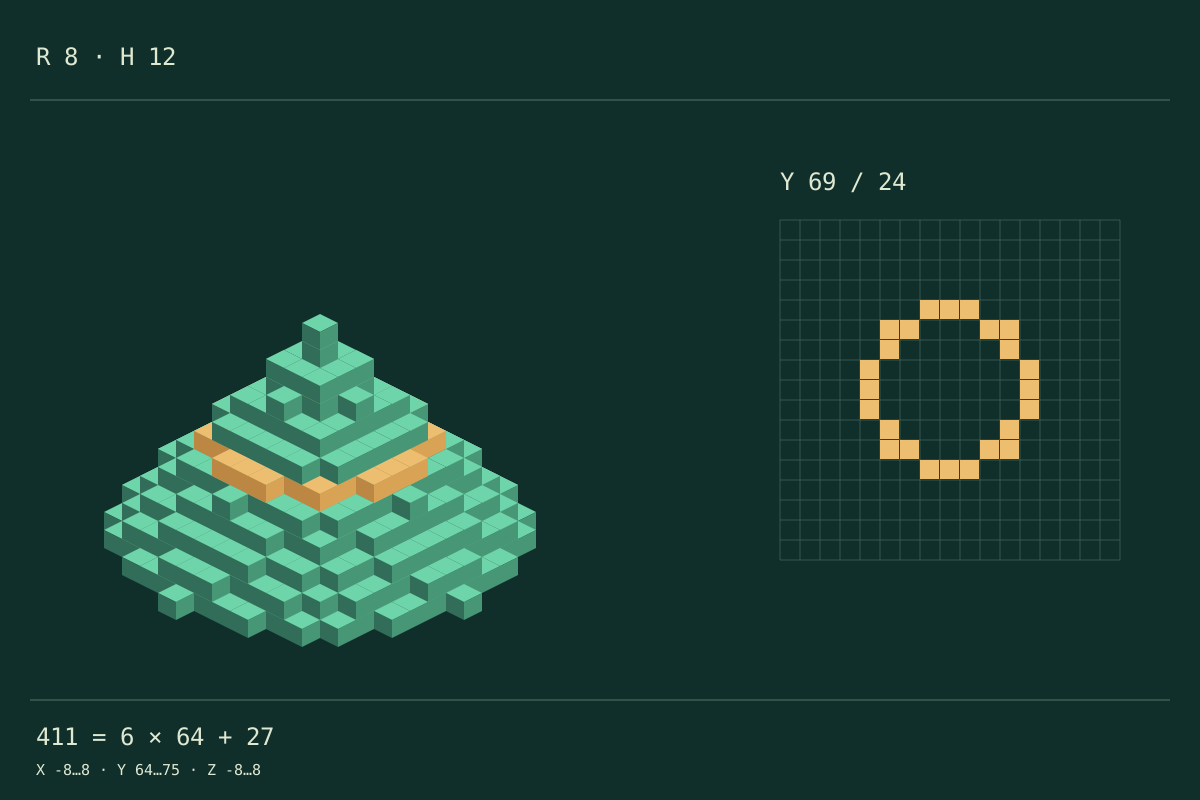
01 / minecraft shape generator
Choose dimensions, then apply the plan.
Loading plan
Block preview
Select an occupied cell to inspect its coordinates.
Selected cell · World coordinates: 0, 64, 0 · Occupied cell
- Total blocks
- 411
- Layer blocks
- 197
- Stacks of 64
- 6
- Remaining items
- 27
Construction rows · Y 64
Layer blocks: 197 · Stacks of 64: 3 · Remaining items: 5
| Z | X → X | Σ |
|---|---|---|
| -8 | 0 → 0 | 1 |
| -7 | -3 → 3 | 7 |
| -6 | -5 → 5 | 11 |
| -5 | -6 → 6 | 13 |
| -4 | -6 → 6 | 13 |
| -3 | -7 → 7 | 15 |
| -2 | -7 → 7 | 15 |
| -1 | -7 → 7 | 15 |
| 0 | -8 → 8 | 17 |
| 1 | -7 → 7 | 15 |
| 2 | -7 → 7 | 15 |
| 3 | -7 → 7 | 15 |
| 4 | -6 → 6 | 13 |
| 5 | -6 → 6 | 13 |
| 6 | -5 → 5 | 11 |
| 7 | -3 → 3 | 7 |
| 8 | 0 → 0 | 1 |
JSON and CSV contain world coordinates; SVG contains the selected layer.
From dimensions to courses
Four passes through the minecraft shape generator
Keep the origin fixed.
Pick a solid
Select a hexagonal prism, cone or frustum. A prism repeats its footprint; the other forms change radius between their end layers.
Set the dimensions
Enter the radius, height and world origin. Choose hexagon orientation or the frustum top radius only when that setting applies.
Inspect the surface
Switch between solid and capped shell, apply the settings, then move through layers. Check row endpoints rather than estimating lengths from the picture.
Take the placements
Review the total and selected-layer materials. Download coordinates for the complete volume or an SVG drawing of the layer you are currently examining.
Three solids, one coordinate reference
What this minecraft shape generator models
Hexagons with a defined radius
The minecraft hexagon generator measures from the centre toward a vertex. Flat and pointy orientations swap the axes. Integer centres are tested against six boundaries, not a stretched circle.
A taper with both ends included
The minecraft cone generator reduces section radius linearly with height. Frustums accept a separate top radius, including a wider upper end. Both end courses use their specified radii.
A shell with closed ends
Surface mode keeps cells with a missing face neighbour, including the base and top. Thin shapes retain nearly every cell because little enclosed interior exists.
Rows that respect empty space
A hollow course can have several runs on one Z coordinate. Inclusive X endpoints preserve empty interiors. Materials count only emitted cells.
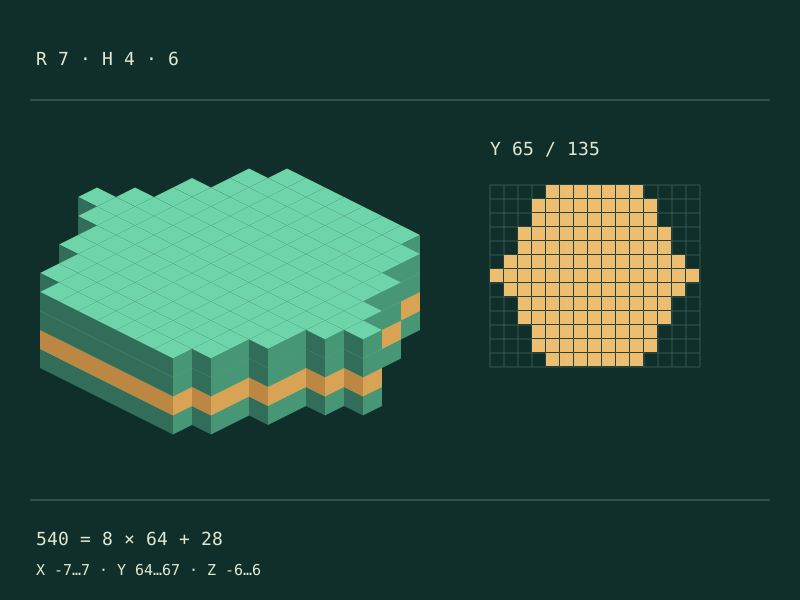
Before laying the foundation
Three details that change the build
The origin belongs to the base centre
World X and Z identify the footprint centre; world Y identifies its bottom course. This is not the bounding corner. Translating the origin preserves material totals.
A smooth radius makes stepped courses
Intermediate radii can be fractional. Sampling block centres produces repeated footprints followed by reductions. Increasing height does not guarantee a different footprint on every course.
The shell is not a structural promise
The neighbour test finds a surface, not doorways, supports or a walkable room. Add openings separately and check gravity-sensitive materials in your world.
Match the tool to the volume
A volume planner rather than a tool directory
Compare construction tasks.
Circle or oval
Six-sided boundaries and changing section radii.
Better for a single rounded footprint with its own dimensions.
Sphere tool
A linear taper or a constant hexagonal section.
A rounded volume follows a different section profile.
World editor
Files for inspection; no automatic world changes.
An editor can apply operations inside a supported game environment.
Rules you can reproduce
Reproduce the minecraft shape generator rules
A cone finishes with one centre cell because its final radius is zero. Height two means a base and apex, with no additional intermediate courses.
A solid hexagonal prism repeats its footprint. Shell mode closes the first and last courses; compare them with a middle course to inspect removed interior cells.
Use a different section when appropriate
Different profiles, different tools.
Questions before stacking the next course
Does shell mode leave the bottom open?
No. The surface includes exposed bottom and top cells. A capped shell is not an open tube; remove a floor only after checking the resulting plan.
Can a frustum widen upward?
Yes. Its top radius is independent of its base radius. The same interpolation handles narrowing and widening, while allocation limits still apply to the larger end.
Why is the hexagon not exactly twice the radius wide?
Radius points toward a vertex. Orientation and integer centre sampling determine the occupied width; read the generated bounds rather than assuming a continuous diameter equals a block count.
Why can valid dimensions still be rejected?
The planner limits the candidate box to one million cells and output to 250,000 placements. Radius is 1–64 and height at most 128; the combination must also fit the resource budget.
Are downloaded coordinates relative?
No. JSON and CSV contain world coordinates using your entered origin. The SVG represents one selected layer, not the whole three-dimensional object.
Check the end courses before collecting blocks
Use the minecraft shape generator to compare base, middle and top. Keep exported coordinates beside your build.
Open the shape workbenchIndependent project; not an official Minecraft product or affiliated with Mojang or Microsoft.